


Retrieval-Augmented Optimization How Websites Can Thrive with RAO
- systems. It ensures content is easily discoverable and retrievable by Large Language Models (LLMs) and RAG-based tools.
Key Focus
- Targets AI answer engines and conversational platforms.
- Optimizes content for zero-click searches, where answers are delivered directly.
- Emphasizes structured, authoritative, and contextually clear content.
Core Tactics
- Structured Data: Apply schema markup for machine readability.
- Conversational Content: Write clear, concise answers to user queries.
- Trustworthiness: Use factual, credible sources to build authority.
- Entity Optimization: Focus on people, places, and concepts, not just keywords.
Example
A cybersecurity firm structures its research papers in a vector database. This allows ChatGPT to retrieve a direct answer to What is SOC automation? without linking back to the original site.
Goal
The primary goal of RAO is to be the chosen source by AI tools, establishing brand authority even if users never click through.
Absolutely. RAO builds on a foundation of SEO. High-quality, well-structured websites optimized for search engines naturally perform better in AI-driven systems.
For example:
- SEO ensures Google indexes a site properly.
- RAO ensures AI systems can retrieve and trust that content.
By combining keyword strategies from SEO with structured data from RAO, businesses create a synapse that bridges both search and AI ecosystems.
Why the Shift Toward RAO?
User behavior has changed dramatically:
- Over 58% of Google searches in the U.S. are now zero-click, meaning users get answers directly from snippets or AI Overviews.
- Voice assistants and AI chatbots are rapidly becoming default tools for information.
RAO addresses this shift by making sure businesses remain visible in AI-generated responses, not just in Google rankings. Without RAO, even strong SEO strategies risk being overlooked in a world where people expect instant answers.
Practical Takeaways
For SEO
- Continue researching and targeting relevant keywords.
- Strengthen backlinks and domain authority.
- Keep improving technical performance.
For RAO
- Use schema markup and machine-readable structures.
- Focus on answer-first content.
- Ensure data is stored and accessible in vector databases.
- Build trustworthiness through citations and authoritative platforms.
Best Practice
Integrate both strategies. SEO boosts traffic through search, while RAO ensures AI systems select your content. This dual approach creates a synapse between search engines and AI tools, giving businesses full-spectrum visibility.
Future Thoughts
The future of digital visibility doesn’t lie in choosing between SEO and RAO—it lies in combining them. SEO drives website traffic, while RAO ensures your brand remains present in AI-driven answers. Together, they form a powerful synapse that maximizes reach across all platforms.
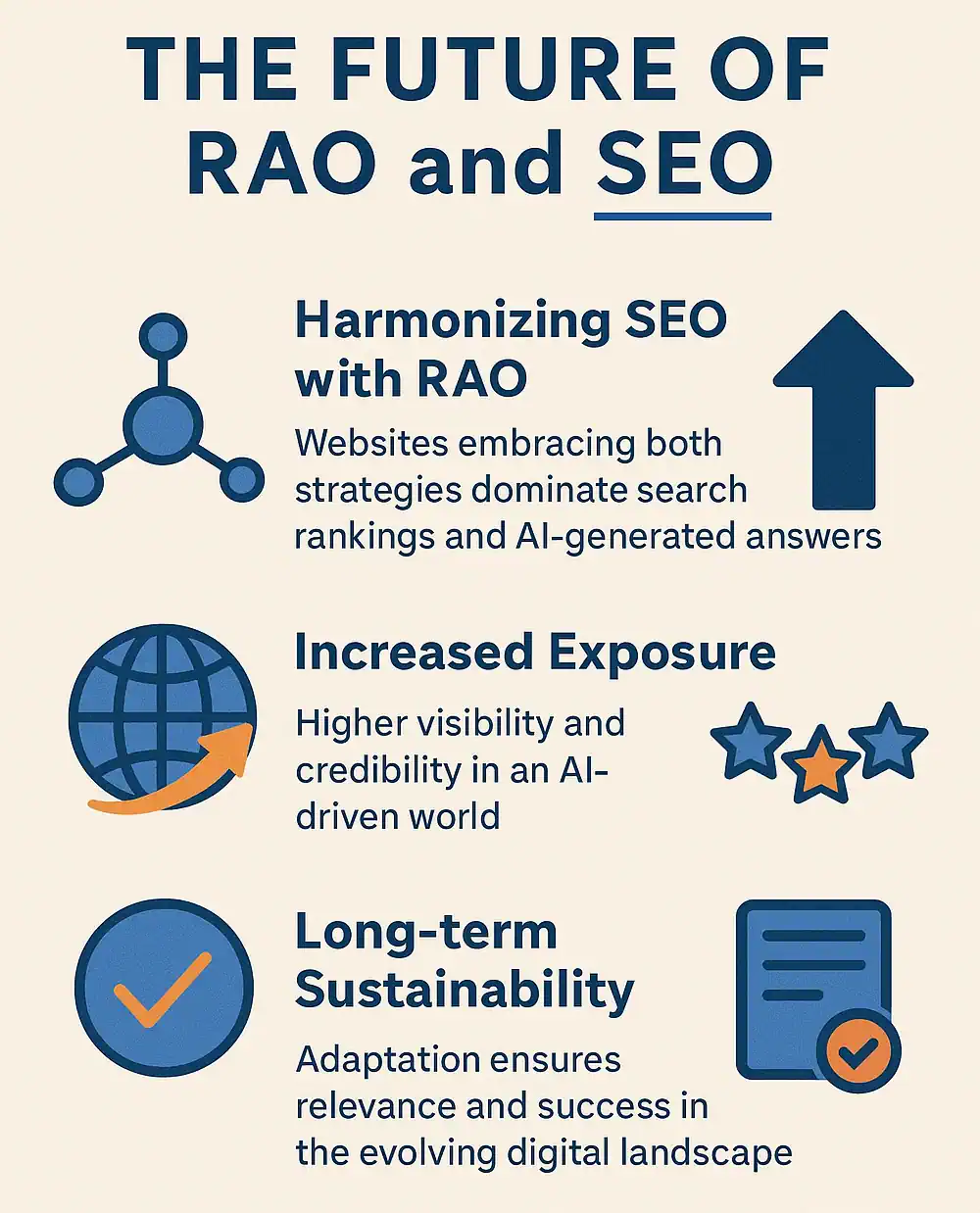
The Future of RAO and SEO
Businesses that adapt now will stay ahead in both Google rankings and AI conversations, ensuring their voice is heard wherever people search.