

reCAPTCHA 2026 Update: Google Shifts to Data Processor — What Website Owners Must Do Now
Quick Facts (2026 Update Snapshot)
- 📅 Effective Date: April 2, 2026
- 🔄 Google role change: Data Controller → Data Processor
- 📜 Governing terms: Google Cloud Data Processing Addendum (DPA)
- ⚙️ Technical impact: No feature or functionality changes
- ⚖️ Legal impact: Website owners become the sole data controller
- 🚨 Required action: Remove references to Google Privacy Policy & Terms for reCAPTCHA
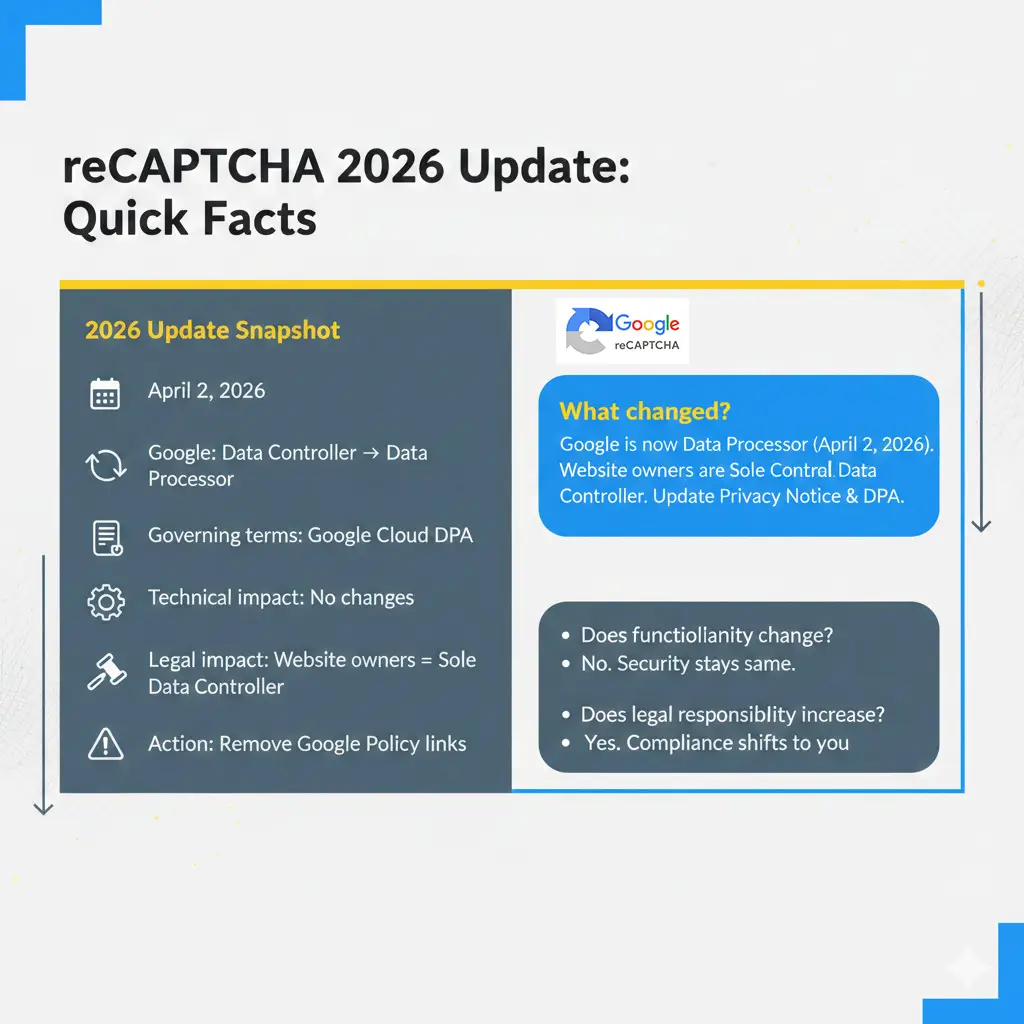
What changed with reCAPTCHA in 2026?
Starting April 2, 2026, Google becomes a data processor instead of a data controller for reCAPTCHA. Website owners now act as the sole data controller, meaning they determine the purpose and legal basis for data collection. You must remove references to Google’s Privacy Policy, update your privacy notice, and ensure your Data Processing Addendum (DPA) is accepted.
Does functionality change? No. Security protection remains the same.
Does legal responsibility increase? Yes. Compliance accountability shifts primarily to you.
Why the reCAPTCHA 2026 Update Matters
If your website uses reCAPTCHA for spam protection, fraud prevention, or contact form security, a major legal shift is happening in 2026.
Beginning April 2, 2026, Google will no longer act as a data controller for reCAPTCHA data. Instead, it will operate strictly as a data processor, meaning it processes data only on your behalf and under your instructions.
From a technical standpoint, nothing changes.
From a legal standpoint, everything does.
This article breaks down:
- What this shift means legally
- What actions you must take
- GDPR, CCPA, and global privacy implications
- Risk levels by business type
- Compliance checklist for 2026
If you operate a business website serving users in the EU, UK, US, Australia, or globally — this update requires attention.
What Exactly Is Changing in 2026?
Before April 2, 2026
Google acted as a data controller for reCAPTCHA. That meant:
- Google determined certain processing purposes
- Users were subject to Google’s Privacy Policy
- Legal accountability was shared
After April 2, 2026
Google will act as a data processor under its Cloud Data Processing Addendum (DPA).
That means:
- You determine the purpose of data processing
- Google processes data only on your behalf
- You carry primary regulatory accountability
- End users are no longer directly subject to Google’s Privacy Policy for reCAPTCHA
No changes to CAPTCHA performance, detection accuracy, or integration are expected.
Legal Implications: You Become the Sole Data Controller
This is the core shift.
Under laws such as:
- GDPR (EU/EEA/UK)
- CCPA / CPRA (California)
- Other global privacy laws
You now:
- Define the purpose of processing
- Establish lawful basis (for EU users)
- Ensure transparency disclosures
- Bear primary enforcement risk
If a regulator investigates data collection via reCAPTCHA, they will look first at your organization — not Google.
What Data Does reCAPTCHA Collect?
While invisible to most users, reCAPTCHA may process:
- IP address
- Browser and device metadata
- Behavioral signals
- Potential cookies
- Interaction data
As the data controller, you must determine:
- Is this “strictly necessary” for security?
- Or does it require prior consent in certain jurisdictions?
This decision directly affects your cookie banner logic and legal risk profile.
Mandatory Website Updates (Non-Negotiable)
If your website currently displays:
“This site is protected by reCAPTCHA and the Google Privacy Policy and Terms of Service apply.”
You must remove references to:
- Google Privacy Policy
- Google Terms of Service
Safer 2026-Compliant Version Example
“We use reCAPTCHA to protect our website from automated abuse. reCAPTCHA is provided by Google and processes certain technical data (such as IP address and device information) on our behalf for security purposes.”
This language reflects the processor relationship accurately.
GDPR & Lawful Basis: What You Must Document
- Establish Legal Basis (EU Context)
Most businesses will rely on:
- Legitimate Interest (Security & Fraud Prevention)
But this requires documentation.
If reCAPTCHA loads before user consent in the EU, you must justify it as “essential security.” Otherwise, consent may be required.
High-risk industries (eCommerce, finance, healthcare) should document their reasoning carefully.
- Conduct a Legitimate Interest Assessment (LIA)
Your LIA should explain:
- Why spam prevention is necessary
- Why impact on users is minimal
- What safeguards exist
- Why security overrides privacy intrusion
This protects you during regulatory inquiries.
- Accept the Google Cloud DPA
You should:
- Accept the updated Google Cloud Data Processing Addendum
- Document Google as a processor in your records
- Maintain version history
Failure to formalize processor agreements is a compliance gap under GDPR Article 28.
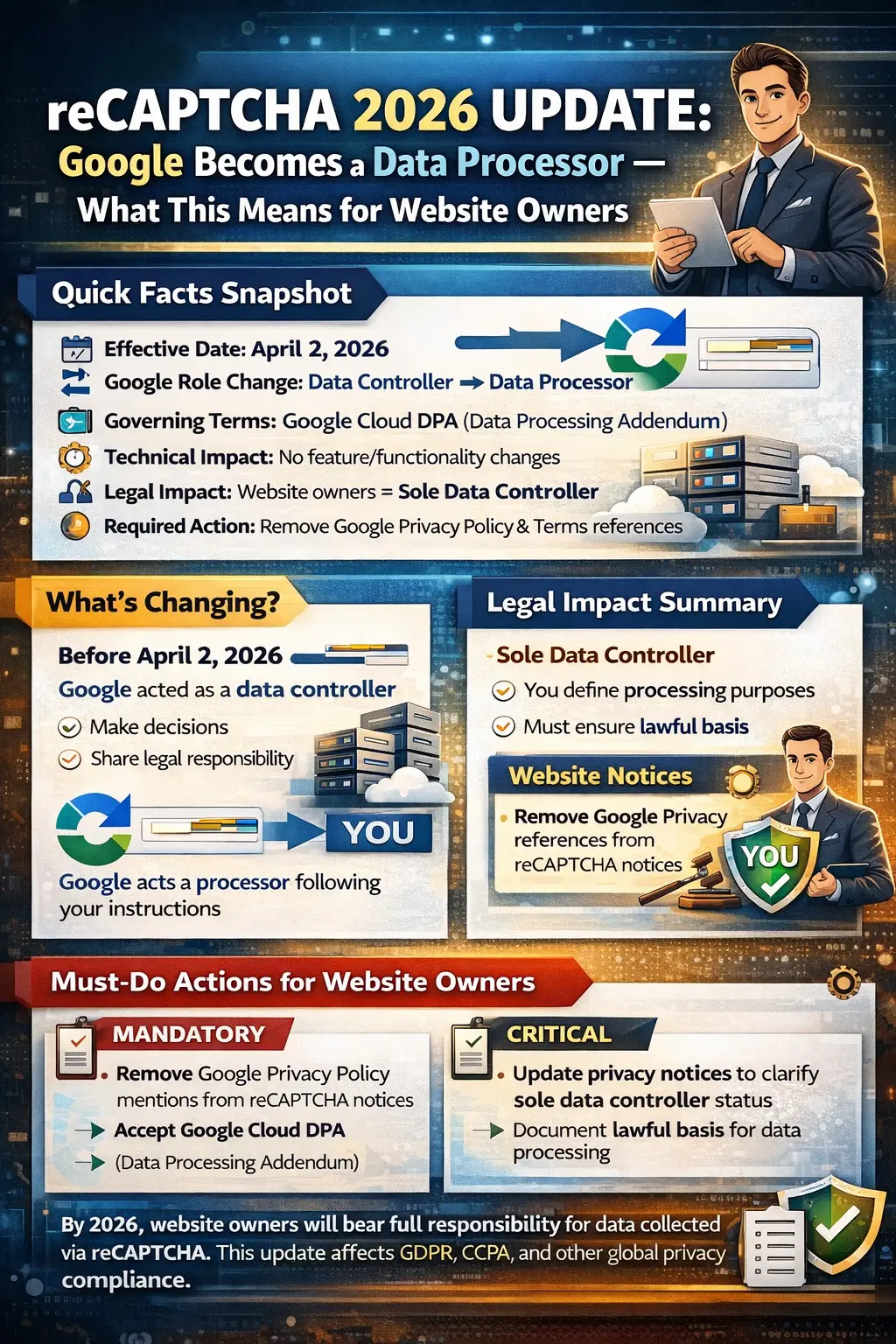
Records of Processing Activities (GDPR Art. 30)
| Category | Description |
| Purpose | Fraud prevention / spam protection |
| Legal basis | Legitimate interest |
| Processor | |
| Data categories | IP address, device metadata |
| Retention | Per service terms |
This strengthens defensibility.
Cookie Banner & Consent Strategy
If reCAPTCHA:
- Sets cookies
- Tracks behavioral signals
- Loads site-wide
You must determine:
- Load immediately as essential
OR - Load only after consent
Ambiguous cookie banners increase enforcement risk in 2026.
International Data Transfers
If you serve EU users:
Confirm:
- Standard Contractual Clauses apply
- Transfer Impact Assessment (if required)
- Data transfer safeguards are documented
Because Google acts as processor, your documentation must reflect this structure.
Risk Levels by Website Type
🟢 Low Risk
- Small blog
- reCAPTCHA on contact form only
- Updated privacy policy
- DPA accepted
Minimal regulatory exposure.
🟡 Medium Risk
- eCommerce site
- reCAPTCHA site-wide
- Outdated policy
- No documented lawful basis
Moderate complaint risk.
🔴 High Risk
- Healthcare or finance
- Sensitive data processing
- No DPA
- No consent logic documentation
High regulatory scrutiny potential.
Governance Checklist for 2026
| Category | Description |
| Purpose | Fraud prevention / spam protection |
| Legal basis | Legitimate interest |
| Processor | |
| Data categories | IP address, device metadata |
| Retention | Per service terms |
This strengthens defensibility.
Cookie Banner & Consent Strategy
If reCAPTCHA:
- Sets cookies
- Tracks behavioral signals
- Loads site-wide
You must determine:
- Load immediately as essential
OR - Load only after consent
Ambiguous cookie banners increase enforcement risk in 2026.
International Data Transfers
If you serve EU users:
Confirm:
- Standard Contractual Clauses apply
- Transfer Impact Assessment (if required)
- Data transfer safeguards are documented
Because Google acts as processor, your documentation must reflect this structure.
Risk Levels by Website Type
🟢 Low Risk
- Small blog
- reCAPTCHA on contact form only
- Updated privacy policy
- DPA accepted
Minimal regulatory exposure.
🟡 Medium Risk
- eCommerce site
- reCAPTCHA site-wide
- Outdated policy
- No documented lawful basis
Moderate complaint risk.
🔴 High Risk
- Healthcare or finance
- Sensitive data processing
- No DPA
- No consent logic documentation
High regulatory scrutiny potential.
Frequently Asked Questions (FAQ) reCAPTCHA 2026
- Does reCAPTCHA stop working in 2026?
No. There are no functional or performance changes.
- Do I need user consent before loading reCAPTCHA?
In the EU, it depends on whether you classify it as essential security. Documentation is critical.
- What happens if I don’t update my privacy policy?
You risk legal inconsistency and regulatory exposure.
- Do small blogs need to sign the DPA?
Yes, if serving EU users.
- Does this affect reCAPTCHA v2 and v3?
The role change applies regardless of version.
- Is this change global?
Yes, but compliance impact depends on jurisdiction served.


