


What is Generative Engine Optimization (GEO) and Why Does It Matter for Your Business?
When people think about being found online, the first thing that usually comes to mind is Google search results. For years, the goal was simple: make sure your website showed up as high as possible on the first page when someone searched for what you offer. This practice is called Search Engine Optimization (SEO).
But times are changing. Today, more and more people are not just typing into Google—they are asking questions to AI systems like ChatGPT, Perplexity, or Google’s new AI-powered tools. Instead of giving a list of websites, these tools provide direct answers. This shift has created a new need for businesses to adapt. That’s where Generative Engine Optimization (GEO) comes in.
Understanding GEO in Simple Terms
Generative Engine Optimization (GEO) is the process of shaping your online content so that AI systems can easily find it, understand it, and use it in their answers.
Think of it like this: if SEO was about impressing Google’s search results, GEO is about teaching AI assistants how to talk about your business.
When someone asks an AI tool a question—for example, “What’s the best bakery in London for fresh sourdough?”—the AI scans through lots of online information and then forms an answer. If your bakery’s website has clear, structured, and well-written content, the AI is more likely to include your business in its response.
If your content isn’t optimized, you risk being left out of the conversation, even if your business is a perfect match.
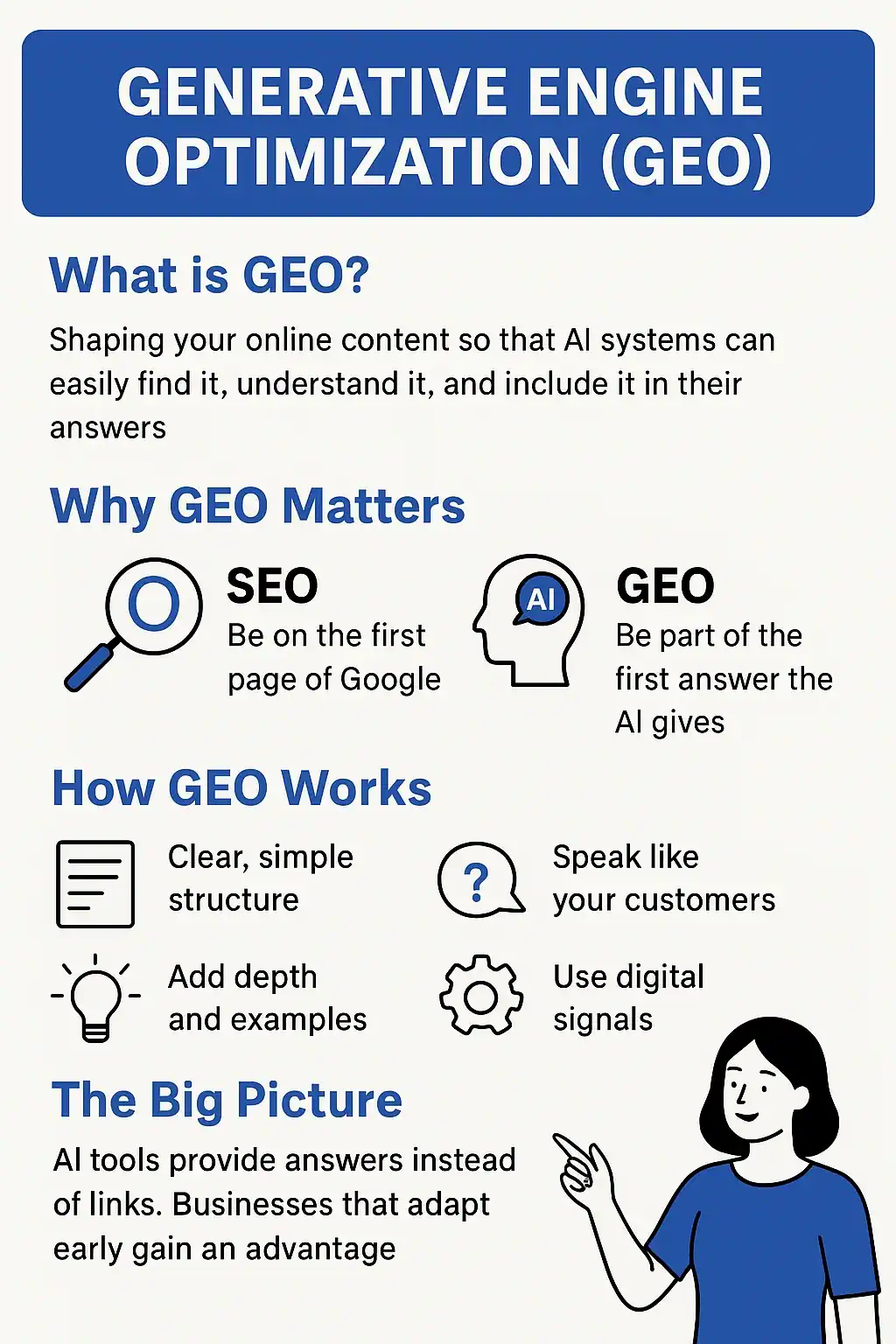
What is Generative Engine Optimization (GEO) Infographic
Why GEO Matters for Businesses
Here’s the big reason GEO is so important:
- With SEO, the goal was to be on the first page of Google.
- With GEO, the goal is to be part of the first answer the AI gives.
Imagine a potential customer asking ChatGPT or Google AI about a product or service you provide. If your content is optimized, the AI doesn’t just share information—it can highlight your business by name. That means your brand is introduced directly in the moment someone is looking for a solution.
In other words, GEO is like having your business included in the first sentence of a conversation—instead of buried in a long list of search results.
How GEO Works (Without the Jargon)
Here are the main ways businesses can prepare their content for GEO, explained in everyday language:
- Clear, simple structure
Write content in a way that’s easy to follow. Use headings, bullet points, and short sections. AI systems “read” content like humans do—they prefer clarity over confusion. - Add depth and examples
Don’t just say what you do—explain it with details, examples, and helpful information. AI tools pick up on context and credibility, so richer content is more likely to be included. - Speak like your customers
Use natural language that matches how real people ask questions. Instead of stuffing in keywords, write content that mirrors what someone might type or say out loud. - Use digital signals
Things like FAQs, schema markup (behind-the-scenes code that helps systems understand your content), and structured data help AI quickly identify and categorize your business. - Make sure your brand shows up
It’s not enough for AI to simply pull facts—you want it to attribute the answer to your business. By writing clearly and connecting your brand name to your expertise, you make it easier for AI to mention you directly.
- Clear, simple structure
The Big Picture
The way people search is evolving. Just like SEO became a must-have skill when Google first took off, GEO will be the next essential step in digital marketing.
- People are asking AI tools questions instead of browsing through pages of links.
- Businesses that don’t adapt risk becoming invisible in this new search environment.
- Those who learn GEO early can secure a valuable advantage: their content will be woven into AI-generated answers, putting them front and center when potential customers are looking for solutions.
What This Means for You
If you’re a business owner with a website, the takeaway is simple: GEO helps your brand be part of the conversation when people ask AI systems for help.
It’s not about complicated tricks or confusing technical language. It’s about creating content that is:
- Clear and structured.
- Rich with useful information.
- Written the way real people ask questions.
- Branded so your business gets credit.
By making these adjustments now, you’ll be ready for the future of online search—where answers come from AI, and your business deserves to be included in those answers.
Generative Engine Optimization (GEO) may sound like a big, technical term, but at its heart, it’s about making sure your business has a voice in the AI-driven world of search. Just like businesses once learned to appear on Google, now it’s time to learn how to show up in AI responses.
The earlier you adapt, the stronger your visibility will be when customers ask the next question that AI is ready to answer.
Boost Your Business with Generative Engine Optimization (GEO)
Ready to make your brand stand out in the AI-driven world of search? Partner with SME Growth Partner to optimize your website with cutting-edge Generative Engine Optimization (GEO) strategies. I’ll help you create clear, structured, and engaging content that ensures your business is the answer when customers ask AI for help. Don’t miss out on the future of search—let’s amplify your online presence and turn clicks into loyal customers today!